The Gastric Signaling Paradigm: Why Mechanical Satiety is the New Frontier of Weight Management
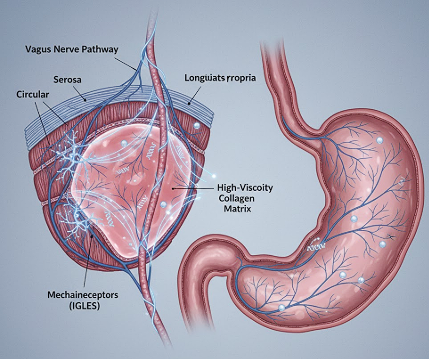
Visualization of high-viscosity gelatin matrix interacting with the stomach's mechanical receptor wall.
For decades, the standard approach to weight management was built on a simple, yet flawed, mathematical equation: calories in versus calories out. However, as medical science advances, we are discovering that the human body does not process a calorie as a simple unit of heat. Instead, our biology relies on a complex network of mechanical sensors to determine when to stop eating.
Current research in neuro-gastroenterology reveals that satiety—the biological "off switch" for hunger—is triggered primarily by physical displacement in the stomach lining. This displacement is monitored by millions of specialized neurons called mechanoreceptors. These sensors are blind to caloric density; they only "see" physical volume and stretching.
The Failure of Caloric Density
In the modern food landscape, hyper-palatable processed foods are designed to be "calorie-dense" but "mechanically small." This means you can consume 1,000 calories of processed snacks without ever triggering the stomach’s stretch receptors. The result is a persistent state of biological hunger, even when the body has more than enough energy. This disconnection between caloric intake and mechanical signaling is a primary driver of weight gain.
This is where the "Gelatin Matrix" provides a unique biological advantage. When specific collagen-based matrices are hydrated and consumed before a meal, they form a high-viscosity gel that occupies significant gastric space. This effectively "pre-loads" the mechanoreceptors, sending a signal of fullness to the brain before the first calorie of a main meal is even consumed.
The 40% Satiety Advantage
Clinical observations have identified a remarkable outcome: Gelatin has been found to be 40% more satiating than other common protein sources like casein or soy. This superior satiety leads to a spontaneous reduction in subsequent energy intake, allowing the body to maintain a caloric deficit without the psychological stress typically associated with traditional dieting.
Hormonal Synergy: The CCK Connection
Mechanical distension is only half of the story. As the stomach detects the presence of a high-viscosity gelatin matrix, it triggers the sustained release of Cholecystokinin (CCK). This hormone acts as a powerful appetite suppressant in the hypothalamus, ensuring that the feeling of "fullness" is both psychological and physiological.
Unlike water, which exits the stomach rapidly, the viscous nature of gelatin slows the rate of gastric emptying. This prolonged presence in the gastric chamber ensures a steady release of CCK, preventing the rapid return of hunger pangs that often lead to snacking and overconsumption. The relationship between dietary viscosity and appetite control is one of the most promising areas for sustainable weight management research in 2026.
A Biological Solution for Long-Term Support
By using a non-caloric, mechanical matrix to occupy 15-20% of gastric volume, we aren't just "dieting"—we are restoring the body’s innate architectural sensors. This "pre-stretch" technique allows the brain to receive a clear satiety signal, making portion control a secondary effect of biology rather than a primary effort of willpower.

Practical preparation of the gelatin matrix to ensure structural stability within the gastric environment.
Implementing the Satiety Protocol
While the mechanical principle of satiety is straightforward, the biological effectiveness of the gelatin matrix depends entirely on its structural integrity. Our team has reviewed available health resources and digital guides to identify the precise variables used in successful satiety protocols. Successful implementation at home requires specific knowledge that goes beyond a simple recipe:
- The Blooming Phase: The exact temperature thresholds required to hydrate collagen without denaturing its mechanical properties.
- The Timing Window: The critical 20-minute "metabolic gap" where the matrix must be consumed to align with hormone release.
- Source Selection: Identifying the difference between high-density bovine collagen and standard culinary gelatin.
- The Formulation: How to maintain matrix stability to survive early gastric acidity levels.
Because these practical details are essential for those seeking to apply this research, we recommend the comprehensive digital roadmap below, currently available via digital retailers like Amazon.
The 2026 Satiety Matrix Implementation Guide
A complete educational resource to translate gastric signaling research into a daily routine. This digital guide contains shopping lists, preparation temperatures, and the full 30-day implementation calendar.
GET THE PROTOCOL ON AMAZON FOR $14.95- Hochstenbach-Waelen, A., et al. (2009). Gelatin intake promotes satiety but not weight loss in comparison to casein. PubMed ID: 19291050.
- Cummings, D. E., & Overduin, J. (2007). Gastrointestinal satiety signals II. Cholecystokinin. PubMed ID: 17056637.
- Phillips, R. J., & Powley, T. L. (2000). Gastric volume rather than nutrient content inhibits food intake. PubMed ID: 10956262.
- Wanders, A. J., et al. (2011). Effects of dietary fibre and viscosity on satiety: a systematic review. PubMed ID: 21676152.